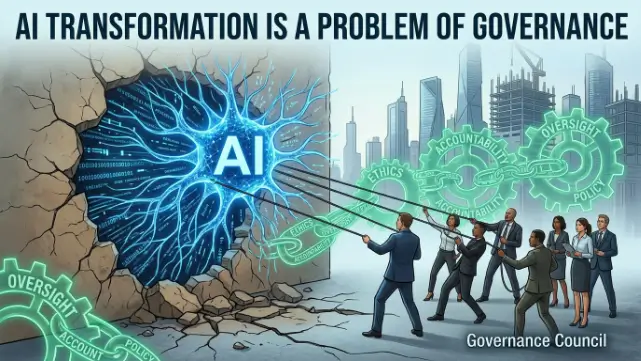
AI Transformation Is a Problem of Governance: Understanding the Real Challenge Behind Artificial Intelligence

Artificial intelligence is transforming the world at an incredible pace. Businesses are using AI to automate tasks, governments are exploring AI-powered public services, and consumers interact with AI every day through search engines, virtual assistants, recommendation systems, and chatbots. While many discussions focus on technology, innovation, and economic opportunities, a growing number of experts argue that AI transformation is a problem of governance rather than simply a technological challenge.
The technology itself is advancing rapidly. The bigger question is how organizations, institutions, and governments manage its development, deployment, and impact. Without effective governance, even the most advanced AI systems can create risks related to privacy, fairness, accountability, security, and public trust.
As AI becomes deeply integrated into society, understanding why AI transformation is a problem of governance is essential for businesses, policymakers, and everyday citizens. This article explores the governance challenges surrounding AI, why they matter, and how organizations can address them responsibly.
What Does “AI Transformation Is a Problem of Governance” Mean?
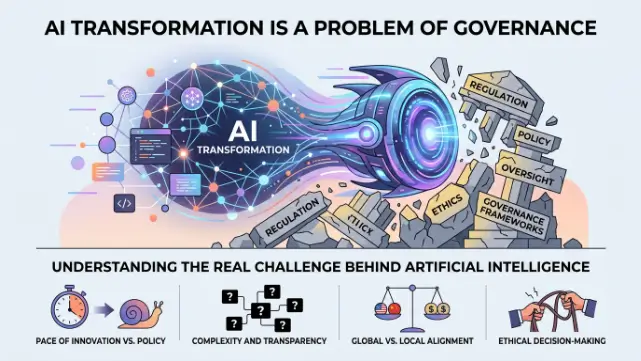
When people discuss AI transformation, they often focus on algorithms, computing power, and data. However, technology alone does not determine outcomes. Human decisions guide how AI is built, used, monitored, and regulated.
Saying that AI transformation is a problem of governance means that the biggest challenges are not technical but organizational and institutional.
Governance involves:
- Decision-making processes
- Policies and regulations
- Accountability structures
- Risk management
- Ethical standards
- Oversight mechanisms
In simple terms, governance determines who makes decisions, how those decisions are made, and who is responsible when things go wrong.
Why Governance Matters More Than Technology
Many organizations successfully develop AI tools. The real challenge begins when those tools influence people, businesses, and society.
Consider these examples:
Hiring Systems
Some companies use AI to screen job applicants.
Without proper governance:
- Biases may affect hiring decisions.
- Qualified candidates may be overlooked.
- Organizations may face legal and ethical issues.
Healthcare Applications
AI can assist doctors in diagnosing diseases.
Without governance:
- Incorrect recommendations could harm patients.
- Accountability may become unclear.
- Trust in healthcare systems may decline.
Financial Services
Banks increasingly use AI for loan approvals.
Poor governance can result in:
- Unfair decisions
- Discrimination
- Regulatory violations
These examples demonstrate why AI transformation is a problem of governance rather than merely a technical challenge.
The Rapid Growth of Artificial Intelligence
AI adoption continues to expand across industries.
Recent studies indicate that businesses worldwide are investing billions of dollars annually in AI technologies. Large organizations increasingly view AI as a strategic priority.
AI is being used in:
- Customer service
- Manufacturing
- Education
- Healthcare
- Transportation
- Banking
- Retail
- Government services
While adoption grows rapidly, governance structures often struggle to keep pace.
This gap creates risks that can affect organizations and society as a whole.
The Core Governance Challenges of AI
Accountability
One of the biggest governance questions is:
Who is responsible when AI makes a mistake?
Consider a situation where an AI system:
- Rejects a qualified job applicant
- Misdiagnoses a patient
- Approves a fraudulent transaction
Responsibility may involve:
- Software developers
- Business leaders
- Data scientists
- Third-party vendors
Without clear accountability, organizations face confusion and legal risks.
Transparency
Many advanced AI systems operate as “black boxes.”
This means:
- Decisions are difficult to explain.
- Users cannot easily understand outcomes.
- Organizations struggle to justify recommendations.
Transparency is critical because people want to know:
- Why a decision was made
- What data was used
- How conclusions were reached
Governance frameworks help establish transparency standards.
Data Privacy
AI systems rely heavily on data.
This data may include:
- Personal information
- Financial records
- Health data
- Consumer behavior
Poor governance can lead to:
- Privacy violations
- Unauthorized access
- Data misuse
Strong governance ensures that data is collected, stored, and used responsibly.
Bias and Fairness
AI systems learn from historical data.
If that data contains biases, AI may reproduce or even amplify them.
Examples include:
- Gender bias
- Racial bias
- Economic bias
- Geographic bias
Governance mechanisms help organizations:
- Test systems regularly
- Monitor outcomes
- Reduce unfair treatment
Fairness is not a technical setting that can simply be switched on. It requires ongoing governance.
Why Businesses Struggle with AI Governance
Many organizations focus heavily on implementation but spend less time developing governance frameworks.
Common challenges include:
Lack of Expertise
Many executives understand business operations but may not fully understand AI risks.
Rapid Innovation
Technology evolves faster than organizational policies.
Fragmented Responsibility
Different departments often manage:
- Data
- Technology
- Compliance
- Risk management
Without coordination, governance becomes difficult.
Pressure to Innovate
Businesses often prioritize speed and competitiveness.
As a result:
- Governance may be treated as an afterthought.
- Risk management may lag behind deployment.
AI Governance in Government and Public Policy
Governments around the world are developing frameworks to regulate AI.
Policy discussions often focus on:
- Privacy protection
- Consumer rights
- National security
- Ethical AI development
- Risk assessment
Governments face a difficult balance.
Too little regulation can increase risks.
Too much regulation may slow innovation.
Effective governance seeks a middle ground that protects society while supporting technological progress.
Ethical Considerations in AI Governance
Ethics plays a central role in AI transformation.
Organizations increasingly recognize that legal compliance alone is not enough.
Important ethical principles include:
Fairness
AI systems should treat individuals equitably.
Accountability
Organizations must accept responsibility for outcomes.
Transparency
Users deserve clear explanations.
Privacy
Personal data should be protected.
Human Oversight
Critical decisions should involve human review when necessary.
These principles form the foundation of responsible AI governance.
Real-World Examples of Governance Challenges
Facial Recognition Technology
Facial recognition systems have generated controversy in multiple countries.
Concerns include:
- Privacy violations
- Surveillance risks
- Misidentification
The technology itself is not necessarily the problem.
The governance surrounding its use often determines whether it benefits or harms society.
Social Media Algorithms
Social media platforms rely heavily on AI.
Challenges include:
- Misinformation
- Content moderation
- User manipulation
- Algorithmic bias
Governance frameworks help address these issues through policies and oversight.
Autonomous Vehicles
Self-driving vehicles use advanced AI systems.
Governance questions include:
- Who is liable during accidents?
- How should safety standards be enforced?
- What level of testing is required?
These questions illustrate why AI transformation is a governance issue.
Building Effective AI Governance Frameworks
Organizations need structured approaches to AI governance.
Key elements include:
Clear Leadership
Assign responsibility for AI oversight.
This may involve:
- Executive leadership
- Governance committees
- Risk management teams
Risk Assessment
Every AI project should undergo risk evaluation.
Questions should include:
- What could go wrong?
- Who could be affected?
- How can risks be reduced?
Regular Audits
AI systems should be reviewed continuously.
Audits help identify:
- Bias
- Performance issues
- Security vulnerabilities
Employee Training
Employees must understand:
- AI capabilities
- Ethical concerns
- Governance requirements
Training improves organizational readiness.
The Role of Corporate Leadership
Leadership plays a critical role in successful AI governance.
Executives must:
- Set clear expectations
- Promote accountability
- Support ethical decision-making
- Allocate governance resources
Organizations with strong leadership often manage AI risks more effectively.
Why Public Trust Depends on Governance
Trust is essential for AI adoption.
People are more likely to accept AI systems when they believe:
- Decisions are fair
- Privacy is protected
- Oversight exists
- Accountability is clear
Without trust, AI adoption may slow regardless of technological advances.
Governance helps build and maintain that trust.
Future Governance Challenges
As AI continues evolving, new challenges will emerge.
Future concerns may include:
Advanced Autonomous Systems
Increasingly independent AI systems may require new oversight approaches.
Global Standards
Different countries may adopt different regulations.
International coordination will become increasingly important.
AI and Employment
Automation may reshape labor markets.
Governance frameworks will help manage workforce transitions.
Security Risks
AI can strengthen cybersecurity but may also create new threats.
Organizations must prepare for both opportunities and risks.
Best Practices for Responsible AI Governance
Organizations can strengthen governance by following several best practices:
- Establish clear AI policies.
- Define accountability structures.
- Conduct regular risk assessments.
- Monitor systems continuously.
- Ensure human oversight.
- Promote transparency.
- Protect user privacy.
- Address bias proactively.
- Train employees regularly.
- Review governance frameworks frequently.
These practices help organizations manage AI responsibly.
Why Governance Will Define the Future of AI
Many experts believe technological advancement is no longer the primary challenge.
The real question is whether society can govern AI effectively.
Success will depend on:
- Strong institutions
- Responsible leadership
- Ethical frameworks
- Public trust
- International cooperation
Technology can create opportunities, but governance determines whether those opportunities benefit society.
Conclusion
The statement “AI transformation is a problem of governance“ captures one of the most important realities of the modern digital era. Artificial intelligence is advancing rapidly, but technology alone cannot guarantee positive outcomes. The decisions surrounding how AI is developed, deployed, monitored, and regulated ultimately shape its impact on society.
Organizations that focus only on innovation may overlook critical issues such as accountability, transparency, fairness, privacy, and trust. Effective governance provides the structure needed to manage these challenges responsibly.
As AI continues transforming industries, economies, and everyday life, governance will become increasingly important. The future of artificial intelligence will not be determined solely by algorithms or computing power. It will be determined by the people, institutions, and policies responsible for guiding its use.
In the years ahead, organizations that prioritize governance alongside innovation will be best positioned to unlock AI’s benefits while minimizing its risks. Understanding that AI transformation is a problem of governance is the first step toward building a future where technology serves humanity responsibly and effectively.