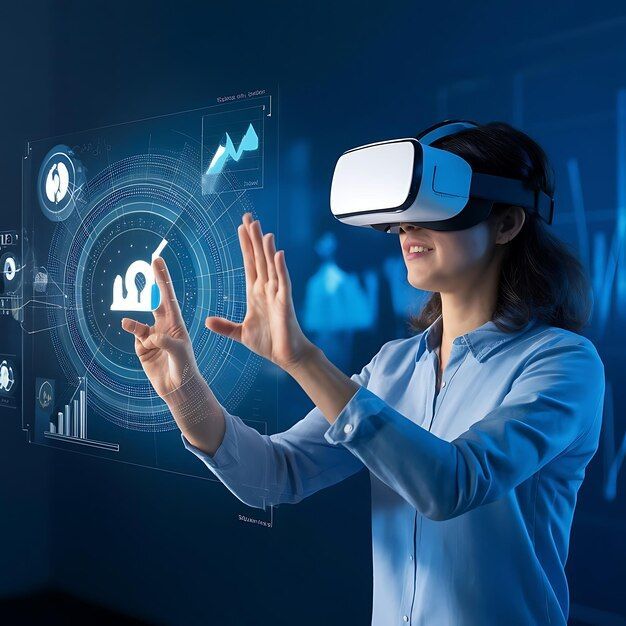

Virtual reality, often called VR, is a technology that allows people to experience computer-generated environments that can feel surprisingly real. Instead of simply looking at information on a traditional screen, VR can place you inside a digital environment where you can look around, move, interact with objects, and sometimes communicate with other people.
You may have seen people wearing VR headsets while playing games or exploring virtual worlds. However, virtual reality is not only about entertainment. The technology is also being explored and used in areas such as education, healthcare, training, design, tourism, engineering, and business.
The basic idea behind VR is simple: create a digital environment that gives a person the feeling of being somewhere else.
This can make ordinary computer experiences much more immersive.
How Does Virtual Reality Work?
Virtual reality works by combining hardware and software to create an interactive digital experience.
The most recognizable piece of VR equipment is the VR headset. The headset contains displays that sit in front of the user’s eyes. These displays show slightly different images to each eye, helping create the perception of depth.
The headset also contains sensors that can track movements.
For example, when you turn your head to the left, the virtual environment can respond by showing what would appear to be on your left side. If you look upward, the digital environment can change to match your movement.
This creates a stronger sense of presence than simply watching a video on a regular screen.
Some VR systems also use handheld controllers. These allow users to interact with virtual objects, press buttons, pick things up, point at objects, or perform other actions.
What Does “Immersive” Mean in Virtual Reality?
One of the most important words associated with VR is immersion.
Immersion describes the feeling of being surrounded by or deeply involved in a digital environment.
Imagine watching a video of a beautiful mountain landscape on your phone. You can see the mountain, but you remain aware that you are sitting in your room.
Now imagine putting on a VR headset and finding yourself standing in a virtual version of that mountain environment. You can turn around and see the landscape in different directions.
That difference is part of what makes VR interesting.
The technology attempts to make the brain feel as though the user is present inside a digital environment rather than simply observing it from the outside.
What Equipment Is Used for Virtual Reality?
A VR experience can involve several different pieces of technology.
VR Headset
The headset provides the visual experience.
It contains screens or displays, lenses, sensors, and other components that help create and maintain the virtual environment.
Modern headsets can also track the position and movement of the user’s head.
Controllers
Many VR systems use handheld controllers.
Controllers allow users to interact with digital environments. Depending on the system, they may include buttons, triggers, joysticks, and motion-tracking technology.
Some newer VR systems can also track hand movements, reducing the need for traditional controllers.
Sensors and Cameras
VR devices may use cameras and sensors to understand the user’s position and movement.
This technology helps the system determine where the user is located and how they are interacting with the virtual environment.
Computers or Processing Hardware
Some VR headsets need to connect to a computer or gaming system to generate complex virtual environments.
Other modern headsets can perform much of the processing themselves.
The hardware requirements depend on the particular VR system and application.
What Is the Difference Between VR and Regular Video Games?
Traditional video games are usually played while looking at a television, monitor, smartphone, or other screen.
The player controls a character or interacts with the game from outside the virtual world.
VR games are different because the player can become part of the environment.
For example, instead of controlling a character who holds a virtual sword, a VR system may allow you to physically move a controller and see a virtual sword respond to your movement.
You can look around naturally and interact with the environment from a first-person perspective.
This makes VR particularly suitable for experiences where immersion is important.
What Is the Difference Between Virtual Reality and Augmented Reality?
Virtual reality and augmented reality are related technologies, but they create different experiences.
Virtual reality replaces the user’s physical surroundings with a digital environment.
Augmented reality, or AR, adds digital information or objects to the real world.
For example, a VR headset might place you inside a completely virtual classroom.
An AR application might display a virtual object on your real desk while you continue to see your physical surroundings.
There are also technologies that combine elements of both approaches.
How Is Virtual Reality Used in Entertainment?
Gaming is one of the most familiar uses of VR.
VR games can allow players to explore virtual worlds, interact with characters, solve puzzles, participate in sports simulations, or experience adventures from a first-person perspective.
But gaming is only one part of the entertainment industry.
VR can also be used for virtual concerts, interactive storytelling, immersive movies, virtual museums, and other experiences.
Instead of simply watching content, users may be able to interact with the environment.
This creates new possibilities for creators who want audiences to feel more involved in their work.
How Is Virtual Reality Used in Education?
Virtual reality can provide students with experiences that may be difficult, expensive, or impossible to recreate in a traditional classroom.
Imagine studying ancient history and being able to explore a virtual recreation of an ancient city.
A science student could potentially explore a three-dimensional model of the human body or examine a virtual laboratory.
Geography students could visit simulated environments around the world without physically traveling.
VR does not replace teachers or traditional learning methods, but it can provide another way to explore information.
One of its potential advantages is that students can learn through interaction rather than relying only on textbooks or two-dimensional images.
How Is VR Used in Healthcare?
Healthcare is another area where virtual reality has attracted attention.
Medical professionals can use virtual simulations for certain types of education and training. Instead of practicing only through written materials or videos, students may be able to interact with simulated medical environments.
VR has also been explored for patient care and rehabilitation.
For example, certain VR experiences can provide controlled environments for physical or cognitive exercises.
Some healthcare applications may also use VR as part of approaches designed to help patients manage pain or anxiety.
However, medical VR applications require appropriate research, professional oversight, and evidence to determine where they are useful.
Virtual Reality for Professional Training
VR can be especially useful for training in situations where mistakes can be expensive or dangerous.
For example, workers can potentially practice operating complex equipment in a simulated environment.
Pilots have used flight simulators for decades, and modern simulation technologies can provide highly detailed training environments.
VR can also be explored for emergency response, industrial training, military training, workplace safety, and other professional scenarios.
The advantage is that learners can practice certain situations without facing the same physical risks associated with real-world training.
How Can Businesses Use Virtual Reality?
Businesses are exploring VR in several ways.
Companies can create virtual showrooms where customers explore products digitally.
Real estate businesses can offer virtual property tours, allowing potential buyers or renters to explore a space without physically visiting it.
Manufacturers can use virtual environments to visualize product designs before creating physical prototypes.
Architects can also use VR to experience buildings or spaces before construction begins.
This can make it easier to identify design problems and understand how a space might feel when completed.
What Are the Benefits of Virtual Reality?
Virtual reality offers several potential benefits.
Greater Immersion
VR can make digital experiences feel more engaging because users can look around and interact with their surroundings.
Interactive Learning
Students can potentially explore complex concepts through simulations and three-dimensional environments.
Safe Training
VR can allow people to practice certain tasks without being exposed to the risks of real-world situations.
Remote Experiences
VR can create virtual experiences for people who cannot physically travel to a particular location.
New Forms of Entertainment
VR gives game developers, filmmakers, artists, and other creators new ways to design interactive experiences.
What Are the Challenges of Virtual Reality?
Despite its advantages, VR also has limitations.
Cost
High-quality VR equipment can be expensive, especially when a powerful computer or additional accessories are required.
Prices have changed as the technology has developed, but cost can still be a barrier for some users.
Motion Sickness
Some people experience dizziness, nausea, or discomfort when using VR.
This can happen when the movement shown in the virtual environment does not perfectly match the user’s physical movement.
Developers continue to work on technologies and design techniques that can make VR experiences more comfortable.
Physical Space
Some VR experiences require users to move around.
This means users need enough safe physical space to avoid hitting furniture, walls, or other objects.
Isolation
Because VR can block or reduce awareness of the physical environment, users may become less aware of people and events around them.
This can be useful for immersion but also means VR should be used responsibly.
Privacy
VR devices can collect various forms of information, potentially including movement data, interactions, and other information depending on the device and application.
As VR develops, privacy and data protection will remain important considerations.
Is Virtual Reality Only for Young People?
No.
Although VR is popular among younger users and gamers, the technology can be useful for people of different ages.
Adults can use VR for education, professional training, virtual travel, exercise, design, entertainment, and communication.
Older adults may also benefit from appropriate VR experiences for recreation, education, or certain forms of supervised therapy and rehabilitation.
As VR becomes easier to use, its audience may continue to expand.
What Does the Future of Virtual Reality Look Like?
The future of virtual reality is still developing.
VR headsets are becoming more capable, while improvements in displays, sensors, processors, hand tracking, audio, and software are making virtual environments increasingly sophisticated.
One important area of development is making headsets smaller and more comfortable.
Another is improving interaction. Instead of relying entirely on controllers, future systems may use better hand tracking, eye tracking, voice commands, and other natural ways of interacting with digital environments.
VR may also become increasingly connected with artificial intelligence, cloud computing, augmented reality, and other technologies.
These combinations could create new types of digital experiences that are difficult to imagine today.
Is Virtual Reality the Same as the Metaverse?
Not exactly.
The metaverse is a broad concept involving persistent or shared digital environments where people may interact, communicate, work, play, or participate in other activities.
Virtual reality is a technology that can be used to access immersive digital environments.
VR can therefore be part of a metaverse experience, but the two terms do not mean exactly the same thing.
A person can use VR without participating in a metaverse, and digital metaverse-like environments can also be accessed through devices that are not VR headsets.
Final Thoughts
So, what is virtual reality?
Virtual reality is a technology that uses specialized hardware and software to create interactive digital environments that can make users feel as though they are somewhere else.
Although gaming is one of its most popular uses, VR has applications in education, healthcare, professional training, business, design, entertainment, and many other areas.
The technology still has challenges, including cost, motion discomfort, privacy concerns, and the need for appropriate physical space. However, continued improvements in hardware and software are making VR increasingly accessible and capable.
The most exciting part of virtual reality is its ability to change how people interact with digital information.
Instead of simply looking at a screen, users can potentially step into the experience.
As technology continues to develop, virtual reality could become an increasingly important part of how people learn, work, communicate, create, and experience digital content.