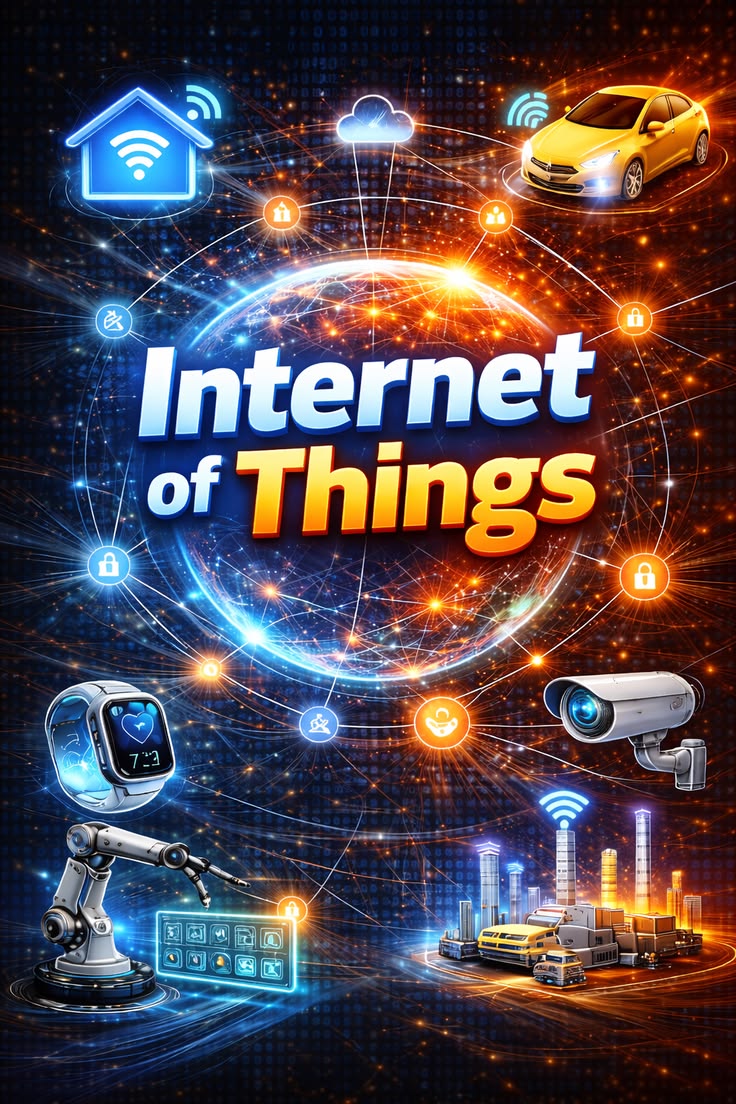

Technology is becoming increasingly connected. Your smartphone can communicate with your smartwatch, your television can connect to the internet, and your home security camera can send notifications directly to your phone. Even refrigerators, cars, thermostats, lights, and other everyday devices can now connect to the internet.
This growing network of connected devices is known as the Internet of Things, commonly shortened to IoT.
The name may sound complicated, but the basic idea is quite simple. The Internet of Things refers to physical objects that can connect to a network, collect information, share data, or respond to commands.
In other words, IoT allows everyday objects to become connected and more intelligent.
You might already be using IoT technology without thinking about it. If you have a smartwatch that tracks your activity, a smart speaker that responds to voice commands, or a security camera that you can monitor from your phone, you are already experiencing the Internet of Things.
What Does the Internet of Things Mean?
The Internet of Things is a broad term for physical devices that are connected to networks and can communicate or exchange information.
These devices can include:
- Smartwatches
- Smartphones
- Smart TVs
- Smart speakers
- Security cameras
- Smart lights
- Smart thermostats
- Connected cars
- Fitness trackers
- Industrial machines
- Medical devices
- Smart appliances
- Agricultural sensors
An IoT device usually contains some combination of sensors, software, processing capabilities, and network connectivity.
The device can collect information from its environment, send that information somewhere, receive instructions, or perform an action.
For example, a smart thermostat can measure the temperature in a room. It can send that information to an application and adjust the temperature based on programmed settings.
How Does the Internet of Things Work?
The Internet of Things generally involves several components working together.
Sensors
Sensors allow devices to collect information from the physical world.
A sensor might measure temperature, movement, light, humidity, location, heart rate, pressure, or other conditions.
For example, a fitness tracker can use sensors to collect information about movement and physical activity.
Connectivity
Once information has been collected, an IoT device needs a way to communicate.
Devices can connect using technologies such as Wi-Fi, Bluetooth, cellular networks, Ethernet, or specialized IoT communication networks.
The method depends on the type of device and what it needs to do.
Data Processing
The information collected by a device may need to be processed.
Some processing can happen directly on the device. Other information may be sent to a computer server or cloud platform for more advanced processing.
For example, a security camera may capture video and send it to a cloud service where software analyzes the footage.
User Interface
Many IoT devices have an application or another interface that allows people to interact with them.
A smartphone app might allow you to control smart lights, check a security camera, monitor a fitness tracker, or adjust a thermostat.
The user may also receive notifications when a device detects something important.
What Are Some Everyday Examples of IoT?
The Internet of Things is already part of many people’s everyday lives.
Smartwatches
Smartwatches can track steps, heart rate, movement, sleep patterns, notifications, and other information depending on the device.
They can communicate with smartphones and online services, making them a common example of consumer IoT.
Smart Home Devices
Smart home technology is another popular part of IoT.
People can connect lights, doorbells, cameras, speakers, thermostats, locks, and appliances to a home network.
Instead of controlling everything manually, users can sometimes control devices through smartphone apps or voice commands.
For example, you might turn off your living room lights from your phone without physically walking to the switch.
Smart Security Cameras
Connected security cameras can allow homeowners to monitor their property remotely.
A camera can detect movement and send an alert to a smartphone.
Some systems can also use software to distinguish between different types of activity.
Connected Cars
Modern vehicles increasingly contain connected technology.
Cars can use sensors and network connections to provide navigation, entertainment, safety features, maintenance information, and other services.
Some vehicles can also communicate with smartphones and online services.
Smart Appliances
Refrigerators, washing machines, ovens, and other appliances can include internet-connected features.
For example, a smart washing machine might allow users to monitor a washing cycle through a mobile application.
These features are designed to make household tasks more convenient.
How Is IoT Used in Healthcare?
The Internet of Things is also becoming important in healthcare.
Connected medical devices can collect and transmit information that may help healthcare professionals monitor patients.
For example, wearable devices can track certain health-related measurements and provide information that can be reviewed by patients or professionals.
Hospitals can also use connected equipment to monitor devices, track assets, manage supplies, and improve operational processes.
However, healthcare IoT involves sensitive information, so privacy, security, reliability, and regulatory requirements are particularly important.
IoT technology should support healthcare professionals rather than replace appropriate medical judgment.
How Is IoT Used in Agriculture?
Agriculture is another area where connected devices can be useful.
Farmers can use sensors to monitor soil moisture, temperature, weather conditions, irrigation systems, and other environmental factors.
Imagine a farm with sensors placed throughout a field.
The sensors could collect information about soil conditions and send it to a central system. Farmers could then use that information to make more informed decisions about watering or managing crops.
This type of technology is sometimes referred to as smart agriculture or precision agriculture.
IoT can help farmers monitor large areas and potentially use resources more efficiently.
How Is IoT Used in Businesses?
Businesses can use IoT devices to monitor equipment, track inventory, improve operations, and collect useful information.
For example, a manufacturing company might install sensors on machines to monitor temperature, vibration, or performance.
If a machine begins behaving differently from normal, the system could alert maintenance staff.
This can support a strategy known as predictive maintenance, where organizations use data to identify potential equipment problems before a major failure occurs.
Retail businesses can also use connected systems to monitor inventory, understand customer behavior, or manage stores.
What Is Industrial IoT?
The term Industrial Internet of Things, or IIoT, refers to IoT technologies used in industrial environments.
IIoT can connect machines, sensors, control systems, vehicles, and other equipment.
Factories, energy companies, transportation systems, and manufacturing facilities can use connected devices to collect information and monitor operations.
Industrial IoT can support automation, maintenance, safety, efficiency, and real-time monitoring.
Because industrial systems can be critical to physical operations, cybersecurity and reliability are extremely important.
What Are the Benefits of the Internet of Things?
IoT can provide several potential benefits.
Convenience
Connected devices can make everyday tasks easier.
For example, you can control smart lights or check a security camera using a smartphone.
Automation
IoT devices can perform certain actions automatically based on information collected from sensors.
A smart thermostat, for example, can adjust settings based on temperature or programmed schedules.
Real-Time Information
Connected devices can provide information as events happen.
This can be useful for businesses, healthcare, transportation, agriculture, and personal technology.
Efficiency
Organizations can use IoT data to identify waste, monitor equipment, and improve processes.
Better Decision-Making
Data collected from connected devices can help people understand what is happening and make more informed decisions.
What Are the Challenges of IoT?
Although IoT offers many possibilities, it also creates challenges.
Security
One of the biggest concerns is cybersecurity.
Every connected device can potentially create another entry point into a network.
If an IoT device has weak security, outdated software, or poorly configured settings, attackers may attempt to exploit it.
This makes strong passwords, software updates, secure networks, and good security practices important.
Privacy
Many IoT devices collect information about users and their environments.
A smartwatch can collect activity information. A smart camera can record video. A connected speaker may process voice commands.
This raises questions about what data is collected, where it is stored, who can access it, and how long it is retained.
Compatibility
Not every smart device works perfectly with every other device.
Different manufacturers may use different technologies and standards.
This can make it difficult for consumers to create a completely connected smart environment.
Cost
Some IoT devices can be expensive to purchase and maintain.
Businesses may also need to invest in networks, software, security systems, data storage, and technical support.
Why Is IoT Security Important?
IoT security is particularly important because connected devices can affect both digital and physical environments.
A compromised computer might expose files, but a compromised smart device could potentially create physical consequences depending on what the device controls.
For example, connected locks, cameras, industrial systems, and vehicles require strong security protections.
Users should change default passwords, install available security updates, use secure networks, and purchase devices from manufacturers that provide appropriate security support.
Businesses should also monitor connected devices and restrict access to systems where appropriate.
What Role Does Artificial Intelligence Play in IoT?
Artificial intelligence and IoT can work together.
IoT devices collect information from the physical world, while AI can analyze large amounts of that information and identify patterns.
For example, sensors in a factory could collect information about machinery. An AI system could analyze the data and identify unusual patterns that might indicate a problem.
In a smart home, AI could potentially learn patterns in how people use lights, heating, or other devices and help automate certain functions.
The combination of AI and IoT is sometimes referred to as AIoT, meaning Artificial Intelligence of Things.
What Is the Future of the Internet of Things?
The number of connected devices is likely to continue growing as technology becomes more affordable and widely adopted.
Homes, businesses, factories, farms, vehicles, and cities can all become more connected.
Smart cities, for example, may use connected sensors to monitor traffic, energy usage, public infrastructure, environmental conditions, and other systems.
As 5G and other communication technologies continue to develop, connected devices may be able to communicate more quickly and reliably in certain applications.
Edge computing may also become increasingly important. Instead of sending every piece of information to a distant cloud server, some data can be processed closer to where it is collected.
This can potentially reduce delays and improve efficiency for certain applications.
Is the Internet of Things Safe?
IoT can be safe when devices are designed, configured, maintained, and used properly. However, no connected system is completely free from security risks.
Consumers should choose reputable devices, change default passwords, keep software updated, use secure Wi-Fi networks, and understand what information their devices collect.
Businesses need even stronger protections because they may have thousands of connected devices operating across large networks.
Security should therefore be considered from the beginning rather than added only after a problem occurs.
Final Thoughts
So, what is the Internet of Things?
The Internet of Things is a network of physical devices that can connect to the internet or other networks, collect information, exchange data, and sometimes respond automatically to commands or changes in their environment.
From smartwatches and security cameras to connected cars, agricultural sensors, industrial machines, and smart home appliances, IoT is already part of modern life.
The technology can make everyday activities more convenient and help businesses collect valuable information. It can also support automation, monitoring, efficiency, and better decision-making.
At the same time, IoT creates important challenges involving cybersecurity, privacy, compatibility, cost, and data management.
As more objects become connected, understanding the Internet of Things will become increasingly important. The future may not simply involve people using computers and smartphones. It may involve billions of connected devices quietly communicating with one another and helping people interact with the physical world in new ways.