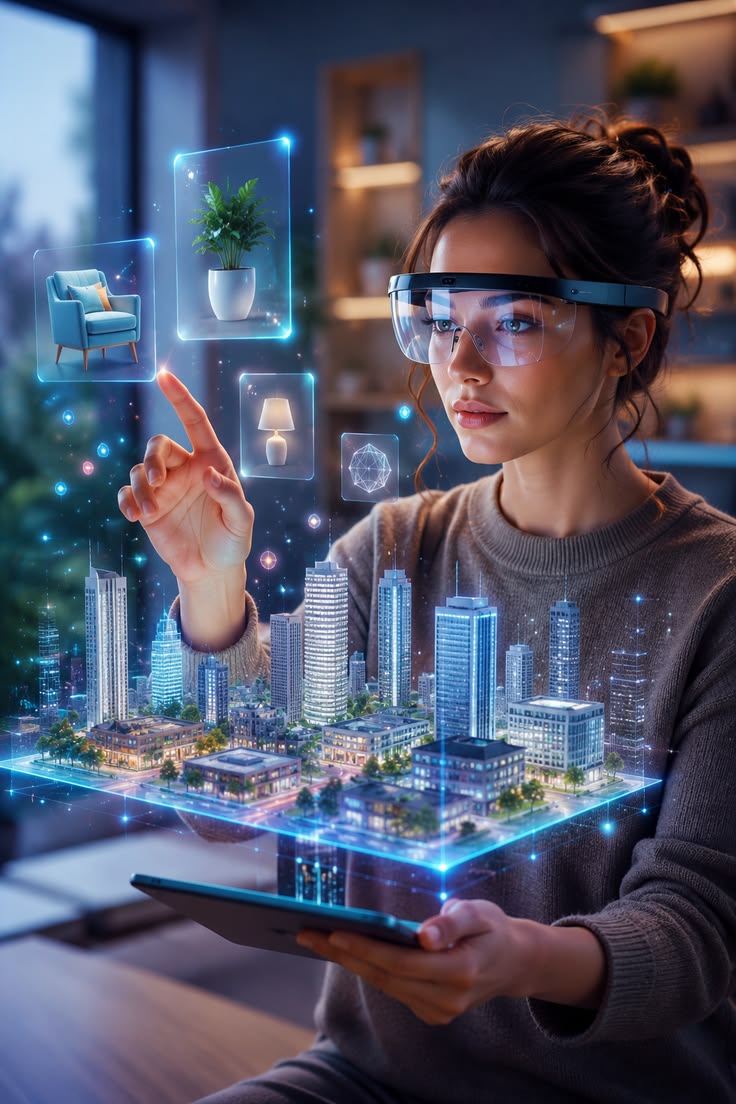


Technology has become increasingly connected to the world around us. Smartphones can recognize objects, cameras can identify faces, and applications can place digital information over the physical environment. One technology that brings digital content into our everyday surroundings is augmented reality, commonly known as AR.
You may have already experienced augmented reality without realizing it. Social media filters that add virtual glasses or animal ears to your face are simple examples. Mobile games that place digital characters into real-world locations can also use AR. Some shopping apps allow customers to see how furniture might look inside their homes before buying it.
But augmented reality is about much more than fun filters and games.
AR is being explored and used in education, healthcare, retail, manufacturing, navigation, tourism, design, entertainment, and many other industries.
So, what exactly is augmented reality?
In simple terms, augmented reality is a technology that adds digital information, images, sounds, or virtual objects to a person’s view of the real world.
Unlike virtual reality, AR does not necessarily replace your surroundings. Instead, it adds digital elements to them.
How Does Augmented Reality Work?
Augmented reality combines cameras, sensors, software, displays, and sometimes artificial intelligence to understand the user’s surroundings and place digital content within them.
Imagine pointing your smartphone camera at a table.
An AR application can use the camera to understand what it sees. The software may identify the table’s position and then place a digital object on top of it.
For example, a furniture application could show a virtual chair sitting on your real floor.
You can move your phone around, and the application attempts to keep the virtual chair in the correct position.
This combination of the real world and digital information is what makes AR different from traditional computer graphics.
What Devices Can Use Augmented Reality?
You do not always need a specialized headset to experience augmented reality.
Smartphones
Modern smartphones can support many AR applications.
The camera captures the physical environment while software adds digital elements to the screen.
This makes smartphones one of the easiest ways for people to experience AR.
Tablets
Tablets can also provide AR experiences.
Their larger screens can make certain applications easier to use, particularly in education, design, shopping, and professional environments.
AR Glasses
Specialized AR glasses can display digital information while allowing the wearer to see the real world.
Unlike a traditional VR headset that can block much of the user’s physical surroundings, AR glasses are designed to combine physical and digital views.
AR glasses can be useful for hands-free applications such as industrial work, navigation, training, and professional assistance.
Head-Up Displays
Some vehicles use head-up displays to show information in the driver’s field of view.
For example, a vehicle might display speed or navigation information without requiring the driver to look down at a separate screen.
Depending on the technology, these systems can be considered related to augmented-reality concepts.
What Is the Difference Between AR and VR?
Augmented reality and virtual reality are often mentioned together, but they create different experiences.
Virtual reality, or VR, creates a digital environment that can replace much of the user’s view of the physical world.
Augmented reality adds digital information to the physical environment.
Imagine you are standing in your living room.
With VR, you might put on a headset and find yourself inside a completely digital environment.
With AR, you could continue seeing your living room while a digital object appears on the floor.
The easiest way to remember the difference is:
VR replaces. AR adds.
There are also technologies that combine elements of both approaches, often described using terms such as mixed reality.
What Are Some Everyday Examples of AR?
Augmented reality is already part of many consumer applications.
Social Media Filters
One of the most familiar examples is the face filter.
An application can use a smartphone camera to recognize a person’s face and place digital effects over it.
The filter might add virtual makeup, glasses, hats, masks, or other visual effects.
Mobile Games
Some mobile games use AR to place digital characters and objects into real-world environments.
Players can use their phone cameras to view virtual elements as though they are located around them.
Shopping Applications
Retailers can use AR to help customers visualize products.
For example, a furniture application might allow you to see how a sofa or table could look in your home.
A clothing or beauty application may allow customers to preview certain products digitally.
This can help people make purchasing decisions without physically testing every product.
How Is AR Used in Education?
Augmented reality can make learning more interactive.
Instead of looking at a flat picture of a complicated object, students could potentially view a three-dimensional digital model.
For example, a biology application could display a 3D model of the human heart.
A history application could show digital information about a historical building.
A geography application could display additional information about locations on a physical map.
The advantage is that students can interact with information rather than simply reading about it.
AR should not replace teachers or traditional learning methods, but it can provide another way of presenting information.
How Is AR Used in Healthcare?
Healthcare is another field where augmented reality can provide useful applications.
Medical professionals can potentially use AR to display information while performing certain tasks.
For example, an AR system might provide visual guidance or display relevant information without requiring a person to constantly look away at a separate screen.
Medical education can also benefit from interactive 3D models.
Students can use digital overlays to explore anatomy and understand complex structures.
Because healthcare is a high-stakes field, AR applications need appropriate testing, professional oversight, and reliable information.
How Is AR Used in Retail?
Retail is one of the industries where AR can directly affect the shopping experience.
One challenge in online shopping is that customers cannot physically see how a product will look in their environment.
AR can help address this problem.
Imagine shopping for a lamp online.
Instead of simply looking at a product photograph, you could use an AR application to place a digital version of the lamp in your room.
You could move around and see how it appears from different angles.
This can make online shopping more interactive.
How Is AR Used in Manufacturing?
Manufacturing companies can use augmented reality for training, maintenance, design, and other activities.
For example, an AR system could display instructions over a piece of machinery.
A worker wearing AR glasses might see which component needs to be inspected or which step should be completed next.
This can reduce the need to constantly look at a separate manual.
AR can also help engineers visualize designs before physical prototypes are produced.
How Is AR Used in Navigation?
Navigation is another promising application.
Instead of looking at a traditional map, an AR application could display directions over the camera view.
For example, arrows could appear on a street to indicate where the user should turn.
This can make directions easier to understand in certain situations.
AR navigation can also be useful inside large buildings such as airports, shopping centers, hospitals, and universities.
What Are the Benefits of Augmented Reality?
AR offers several potential benefits.
Interactive Experiences
AR can turn ordinary surroundings into interactive digital environments.
Better Visualization
People can visualize objects, designs, instructions, and information in context.
Improved Learning
Students can explore concepts through interactive models and digital overlays.
Convenient Information
AR can provide information without requiring users to constantly switch between different applications or screens.
Improved Shopping Experiences
Customers can preview certain products before purchasing them.
Hands-Free Assistance
AR glasses can display information while allowing users to keep their hands available for other tasks.
What Are the Challenges of Augmented Reality?
Despite its potential, AR has limitations.
Hardware Limitations
Not every smartphone or device supports advanced AR features.
AR glasses can also be expensive or uncomfortable for some users.
Battery Usage
AR applications can require cameras, sensors, processors, and displays to operate continuously.
This can consume significant battery power.
Privacy
AR devices use cameras and sensors to understand the surrounding environment.
This creates privacy questions, particularly when other people are captured by cameras without realizing it.
Accuracy
AR systems need to understand physical spaces accurately.
If an application incorrectly identifies an object’s location, a digital object may appear in the wrong place.
Distraction
AR can make information easier to access, but too much digital information can also become distracting.
This is particularly important in situations such as driving or operating machinery.
How Does Artificial Intelligence Help AR?
Artificial intelligence can make augmented reality more powerful.
AI can help applications recognize objects, faces, environments, gestures, and other information.
For example, an AR application might use AI-powered computer vision to identify a table and determine where a virtual object should be placed.
AI can also help AR systems understand spoken commands or personalize digital experiences.
The combination of AI and AR could lead to more natural interactions between people and digital information.
What Is the Future of Augmented Reality?
The future of AR will likely involve improvements in hardware, software, artificial intelligence, displays, sensors, and connectivity.
One major goal is to make AR devices smaller and more comfortable.
AR glasses may eventually become more practical for everyday use, although widespread adoption will depend on factors such as cost, battery life, privacy, design, and usefulness.
Another area of development is better environmental understanding.
Future AR systems may be able to understand physical spaces more accurately and interact with them in more realistic ways.
AI could also make digital assistants more useful within AR environments.
For example, instead of simply displaying information, an AR assistant could understand what the user is looking at and provide relevant guidance.
Is Augmented Reality the Same as Mixed Reality?
Not exactly.
The terms are related, but they describe different ideas.
Augmented reality generally adds digital information or objects to the physical world.
Mixed reality can involve a deeper interaction between physical and digital environments.
For example, a virtual object in a mixed-reality environment might appear to understand physical surfaces and interact with the environment more naturally.
The boundaries between these technologies can sometimes overlap, and terminology can vary between companies and products.
Is Augmented Reality Safe?
AR can be used safely when the technology is designed and used appropriately.
However, users need to remain aware of their physical surroundings.
A person focused on a digital overlay might fail to notice an obstacle.
Privacy is another consideration because AR devices can use cameras and sensors to capture information about the environment.
Users should understand what information an application collects and how it is handled.
AR should also be used responsibly in situations where distractions could create safety risks.
Why Does Augmented Reality Matter?
Augmented reality matters because it changes how people interact with digital information.
Traditional technology often requires users to look at a separate screen.
AR can bring digital information into the environment itself.
Instead of looking at a picture of a product, you can potentially see a digital version of it in your room.
Instead of reading a manual while repairing equipment, a worker could potentially see instructions directly over the machine.
Instead of looking down at a map, a traveler could see navigation information displayed within the surrounding environment.
These possibilities could change the way people learn, shop, work, travel, and communicate.
Final Thoughts
So, what is augmented reality?
Augmented reality is a technology that adds digital information, images, sounds, or virtual objects to the real-world environment.
Unlike virtual reality, which can place users inside a completely digital environment, AR keeps the physical world visible while adding digital elements to it.
AR is already being used in smartphone applications, games, shopping, education, healthcare, manufacturing, navigation, and entertainment.
The technology has many potential benefits, including better visualization, interactive learning, convenient access to information, improved shopping experiences, and hands-free professional assistance.
At the same time, AR has challenges involving privacy, hardware costs, battery usage, accuracy, distraction, and safety.
As artificial intelligence, sensors, displays, and connected devices continue to improve, augmented reality could become increasingly useful.
The biggest idea to remember is simple: augmented reality does not replace the real world—it adds digital information to it.
That ability to combine physical surroundings with digital content could make AR an important part of the future of technology.