
Technology has changed the way people store, access, and use information. In the past, if you wanted to save photos, documents, videos, or other files, you usually needed a computer hard drive, USB drive, memory card, or another physical storage device.
Today, things work differently.
You can take a photo on your phone and automatically store it online. You can create a document on your computer and access it from another device. You can watch movies without downloading them permanently to your computer. Businesses can run software and store enormous amounts of information without keeping all the necessary hardware in their own offices.
A major technology behind many of these activities is cloud computing.
The term may sound technical, but the basic idea is quite simple.
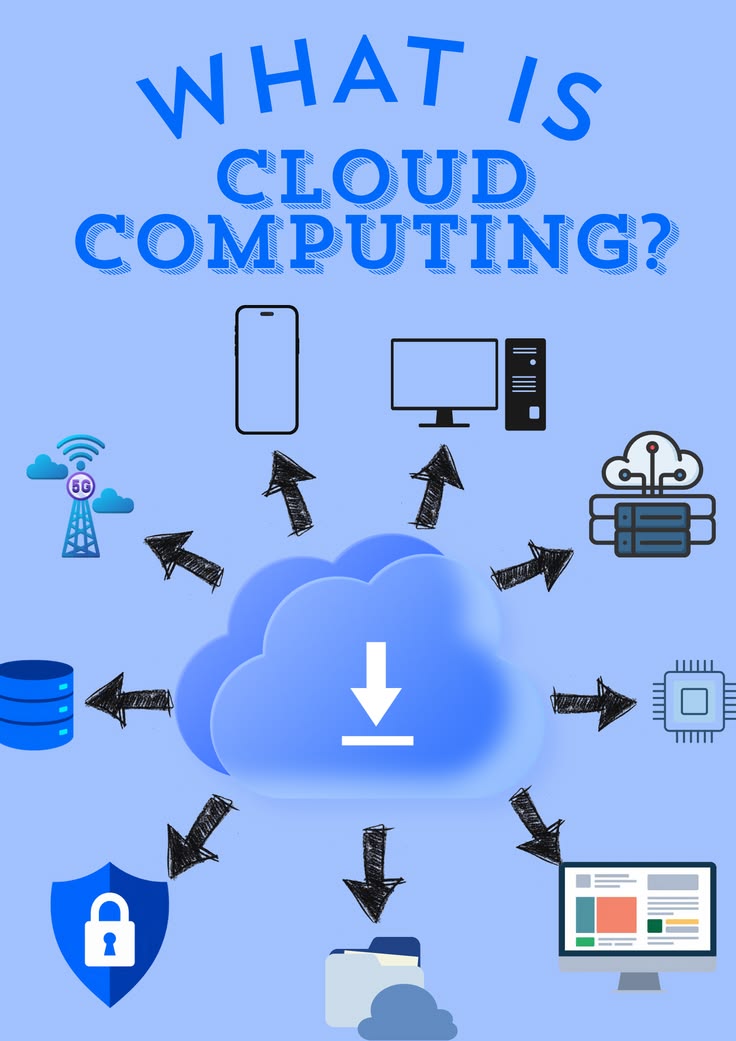
Cloud computing is the delivery of computing services, such as storage, software, servers, databases, and processing power, over the internet.
Instead of relying entirely on your own device or physical servers, you can use computing resources provided through internet-based services.
What Does “The Cloud” Mean?
When people say they are storing something “in the cloud,” they are not talking about the clouds in the sky.
The “cloud” is a general term for remote computing systems that can be accessed through the internet.
For example, when you upload a file to an online storage service, the file is stored on servers located in a data center.
You may not know exactly where those servers are physically located, and you usually do not need to.
You simply access the service through the internet.
This is one of the main ideas behind cloud computing: the physical computing infrastructure exists somewhere else, while users access the services remotely.
How Does Cloud Computing Work?
Cloud computing depends on large networks of computers and servers.
Cloud providers operate data centers containing powerful computing equipment. These systems can provide storage, processing power, databases, networking, software, and other services.
When you use a cloud-based application, your device communicates with these remote systems through the internet.
For example, suppose you use an online document application.
You type a document on your laptop, but the document may be stored on remote servers. You can then open the same document from another device by signing into your account.
Your computer is still important because it provides the interface you use, but much of the underlying computing and storage can happen remotely.
What Are the Main Types of Cloud Computing?
Cloud computing is often divided into several categories.
Infrastructure as a Service
Infrastructure as a Service, commonly called IaaS, provides basic computing infrastructure through the internet.
This can include virtual servers, storage, networking, and other computing resources.
Instead of purchasing and maintaining physical servers, an organization can rent infrastructure from a cloud provider.
This can give businesses more flexibility when their computing needs change.
Platform as a Service
Platform as a Service, or PaaS, provides developers with an environment for building, testing, and deploying applications.
Developers do not necessarily have to manage all the underlying hardware and infrastructure themselves.
The cloud platform handles much of that complexity, allowing developers to concentrate more on creating applications.
Software as a Service
Software as a Service, or SaaS, provides software applications through the internet.
Instead of installing and maintaining traditional software on a computer, users can access the application online.
Examples include online email services, document editing platforms, project management tools, customer relationship management systems, and many other applications.
SaaS is one of the cloud computing models most people encounter in everyday life.
What Are Examples of Cloud Computing?
You may already use cloud computing without realizing it.
Online Storage
Cloud storage allows you to save files on remote servers and access them through the internet.
You can store documents, photographs, videos, and other files without relying entirely on your device’s internal storage.
One advantage is that you can potentially access your files from multiple devices.
Many popular email services operate using cloud infrastructure.
Your messages are stored and processed on remote servers, allowing you to access your inbox from a phone, tablet, or computer.
Streaming Services
When you stream music or video, the content is delivered through the internet from remote servers.
You do not necessarily need to store the entire movie or song collection permanently on your device.
Cloud infrastructure can help streaming platforms deliver content to large numbers of users.
Online Collaboration
Cloud-based collaboration tools allow multiple people to work on documents, spreadsheets, presentations, and projects.
Employees in different locations can work on the same files without necessarily sending separate copies back and forth.
This has become particularly useful for remote and hybrid work.
What Are the Benefits of Cloud Computing?
Cloud computing offers several advantages for individuals and organizations.
Access From Different Devices
One major benefit is accessibility.
If your files or applications are stored in the cloud, you may be able to access them from different devices as long as you have an internet connection and the appropriate account permissions.
You can start working on a document on a laptop and continue from a smartphone or another computer.
Scalability
Cloud services can often be increased or decreased according to demand.
For example, a business website may normally require a certain amount of computing power but experience a large increase in traffic during a major event.
Cloud infrastructure can provide additional resources when needed, depending on the service and configuration.
Reduced Hardware Requirements
Businesses do not always need to purchase and maintain as much physical infrastructure when they use cloud services.
Instead, they can access computing resources from a cloud provider.
This can reduce some hardware management responsibilities.
Collaboration
Cloud applications make it easier for people in different locations to work together.
Employees can share files, communicate, edit documents, and manage projects online.
Automatic Updates
Many cloud-based applications are updated by the service provider.
Users may not need to manually install every update themselves.
This can simplify software management.
What Are the Disadvantages of Cloud Computing?
Cloud computing also has limitations.
Internet Dependence
Because cloud services rely on network connections, internet access can be important.
If your connection is slow or unavailable, accessing certain cloud services may become difficult.
Some applications provide offline functionality, but the level of offline access varies.
Privacy Concerns
Cloud services often store information on remote systems.
Users need to understand how their information is handled, where applicable, and what security measures are available.
Businesses handling sensitive information need to pay particular attention to privacy and data protection requirements.
Security Risks
Cloud providers invest heavily in security, but no online system is completely free from risk.
Weak passwords, compromised accounts, misconfigured systems, and other security problems can expose information.
Organizations need appropriate security practices even when using reputable cloud services.
Ongoing Costs
Cloud computing often involves subscription or usage-based pricing.
While this can reduce large upfront hardware costs, businesses need to manage ongoing expenses carefully.
Is Cloud Computing Secure?
Cloud computing can provide strong security, but security depends on both the cloud provider and the customer.
Cloud providers typically use measures such as encryption, authentication systems, access controls, monitoring, and physical security at data centers.
However, customers are often responsible for configuring their accounts correctly.
For example, a company could use a secure cloud platform but still create problems by giving too many people access to sensitive files.
Users should therefore use strong passwords, enable multi-factor authentication when available, limit unnecessary permissions, and keep systems updated.
Businesses should also have appropriate backup and security policies.
What Is the Difference Between Cloud Storage and Cloud Computing?
These terms are related, but they are not identical.
Cloud storage is specifically about storing data on remote servers that can be accessed through the internet.
Cloud computing is a much broader concept.
It includes storage, processing power, databases, applications, networking, development platforms, and many other computing services.
Cloud storage is therefore one part of cloud computing.
What Is a Public Cloud?
A public cloud provides computing services through infrastructure operated by a cloud provider.
Multiple customers can use the provider’s infrastructure, while their resources and data are logically separated according to the provider’s security architecture.
Public cloud services can be attractive because organizations do not necessarily need to build and operate their own large data centers.
What Is a Private Cloud?
A private cloud is designed for use by a single organization.
The infrastructure may be operated by the organization itself or by a third-party provider.
Private cloud environments can give organizations greater control over certain aspects of their computing environment, although they can also require more management and resources.
What Is a Hybrid Cloud?
A hybrid cloud combines private and public cloud environments.
An organization might keep certain sensitive workloads in a private environment while using public cloud services for other applications.
This approach can provide flexibility, although managing multiple environments can also introduce additional complexity.
How Is Cloud Computing Used by Businesses?
Cloud computing has become an important part of modern business technology.
Companies can use cloud services for:
- Data storage
- Website hosting
- Business applications
- Customer management
- Data analytics
- Software development
- Backup systems
- Communication
- Artificial intelligence
- Collaboration
A small business can use cloud software without building its own data center.
A large organization can use cloud infrastructure to support applications used by customers around the world.
This flexibility is one reason cloud computing has become so important.
How Does Cloud Computing Support Remote Work?
Remote work would be much more difficult without cloud-based technologies.
Employees can use cloud applications to access documents, communicate with colleagues, manage projects, attend meetings, and collaborate from different locations.
Instead of keeping all business files on computers inside a single office, organizations can make appropriate information available through secure cloud systems.
This allows employees to work from home, coworking spaces, offices, or other locations.
Of course, organizations still need appropriate security controls to protect remote access.
What Role Does Cloud Computing Play in Artificial Intelligence?
Artificial intelligence can require significant computing power and storage.
Cloud computing allows organizations to access computing resources without necessarily purchasing large amounts of specialized hardware themselves.
For example, developers can use cloud infrastructure to train or run AI systems.
Cloud platforms can provide access to powerful processors and other resources that can be increased or decreased depending on the workload.
This has helped make advanced computing capabilities more accessible to businesses and developers.
What Is the Future of Cloud Computing?
Cloud computing is likely to remain an important part of the technology industry.
As businesses generate more data and use more digital services, they need flexible ways to store and process information.
Cloud technology is also becoming increasingly connected with artificial intelligence, machine learning, cybersecurity, edge computing, and the Internet of Things.
One important trend is edge computing, where some processing happens closer to the device or location where data is generated.
For example, an IoT device may process certain information locally rather than sending everything to a distant cloud server.
Cloud and edge computing can therefore work together rather than being completely separate technologies.
Why Does Cloud Computing Matter?
Cloud computing matters because it has changed the way people and organizations think about computing resources.
In the past, businesses often needed to purchase physical servers and maintain their own infrastructure.
Today, many organizations can access computing services through the internet.
This makes it possible for smaller businesses and individual developers to access technologies that might previously have required significant investment.
It also makes digital services easier to scale in many situations.
Final Thoughts
So, what is cloud computing?
Cloud computing is the delivery of computing services over the internet. These services can include storage, servers, databases, software, networking, processing power, and development platforms.
You may already use cloud computing when you store photographs online, check your email, stream videos, edit documents, use online business software, or collaborate with people remotely.
Cloud computing can provide flexibility, scalability, accessibility, and convenience. It can also reduce the need for organizations to maintain large amounts of physical computing infrastructure themselves.
At the same time, cloud computing comes with challenges involving internet dependence, privacy, security, cost management, and service availability.
The important thing to remember is that the cloud is not a mysterious place where information disappears. It is a network of physical servers and data centers that provide computing resources through internet connections.
As businesses and individuals continue to rely on digital services, cloud computing will remain an important part of how modern technology works.